
Base rates · Free · Data to October 21, 2026
What happened after a large crypto rose 5x in a year
Zcash is up about 400% in a year and now ranks among the ten largest digital assets. Moves like that are not new. We found every one since 2016 and looked at what came next. This is history, not a forecast.
The short version
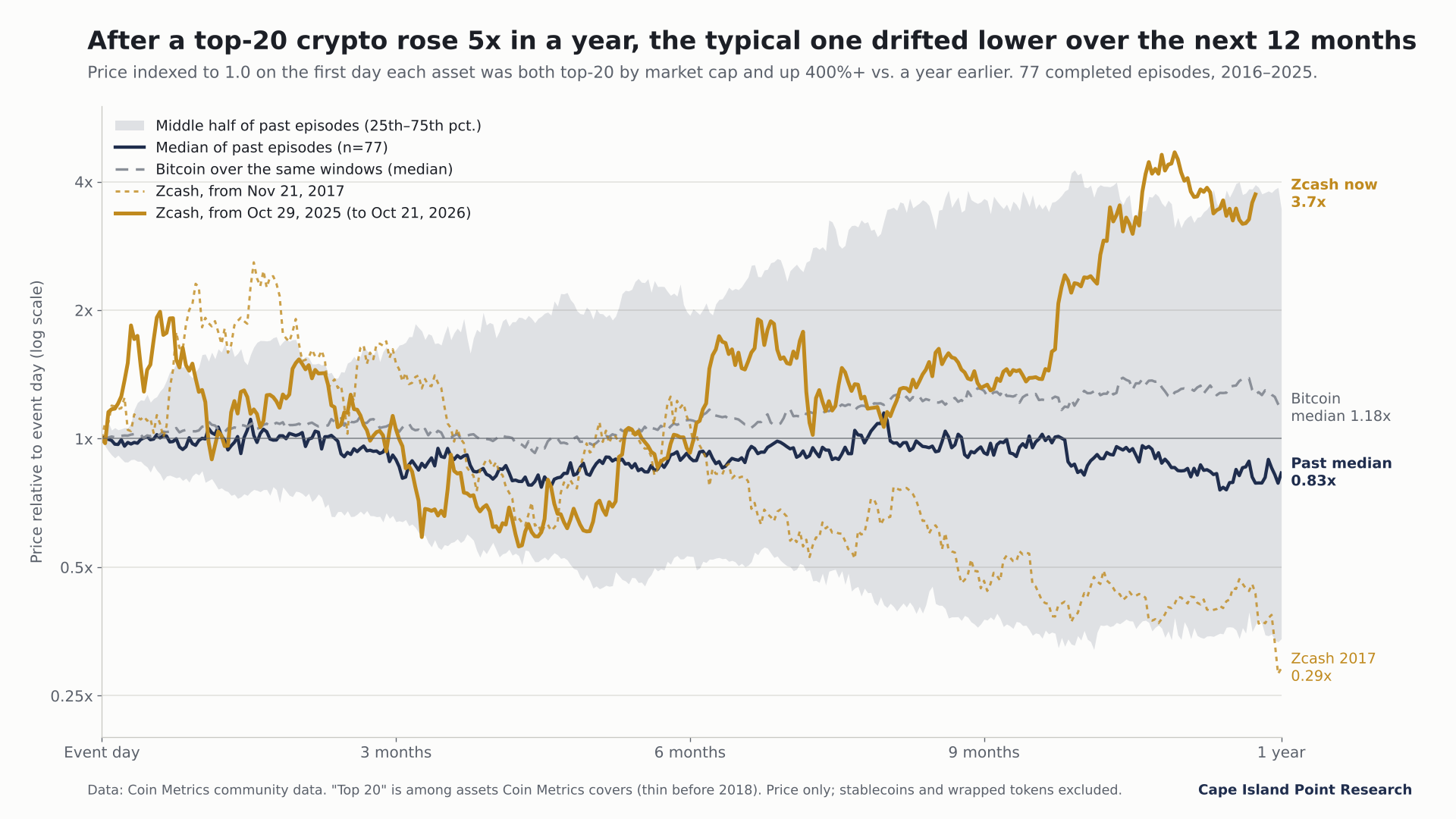
We marked the first day each asset was both one of the 20 largest by market value and up at least 5x from a year earlier: 79 cases across 57 assets. A year after that day, the typical one was down 17% while Bitcoin was up 18% over the same windows. Fewer than half were higher, and about a third did better than Bitcoin. Since 2018 the record is much weaker: a typical fall of about half.
The numbers
| Cases starting in | Cases | Typical change a year later | Share higher | Share that beat Bitcoin | Bitcoin, same windows | Typical worst drop within the year |
|---|---|---|---|---|---|---|
| All years, 2016–2025 | 77 | −17% | 44% | 35% | +18% | −54% |
| 2016–2017 | 17 | +695% | 88% | 59% | +510% | −32% |
| 2018 onward | 60 | −51% | 32% | 28% | −6% | −63% |
| May 2021 onward | 29 | −70% | 7% | 3% | −34% | −75% |
"Typical" is the median. Two cases from late 2025, Zcash and Canton, do not yet have a full year and are left out of these figures.
What stands out
The run usually came near a short-term high. The typical asset closed below its starting price within two days. Most still had a chance to sell higher: the typical best point in the following year was about double the starting price. But more than half fell by half or more at some point in the year.
The market mattered more than the coin. The cases that kept climbing mostly came at the start of a broad rally, in 2016–17 and late 2020, when nearly everything rose. The 2021 cluster (31 cases) came near the top of one, and only about a quarter were higher a year later. In 2024, Bitcoin rose 54% over the following year while the ten assets that met the rule fell by about half.
The range is wide. Since 2018 the best year afterwards belonged to Terra (LUNA, March 2021, +794%), which collapsed to nearly zero about two months after that year ended. Cardano, Ether and OKB in late 2020 each rose more than 5x again. The worst were Mantra (OM, February 2025, −99%) and a late-2021 group — Fantom, Axie Infinity, MultiversX and NEAR — each down more than 90%.
Recovering the peak took time. 42% of all cases eventually rose above their post-run high; for those that did, it took about two and a half years.
Where Zcash sits
Zcash first met the rule on October 29, 2025, at $353, up about 9x on its year. It then fell 44%, to $197 in March 2026, before the run that took it to $1,653 on September 26. On October 21 it stood at about 3.7 times its starting price, higher than about three-quarters of past cases at the same point. So far it has been an exception to the pattern above, not an example of it.
Its previous run is in the record too. Zcash met the rule on November 21, 2017, and finished that year down 71%.
What this does and does not say
It describes what happened after past moves of this size. It does not say what Zcash or any other asset will do next, and it is not a reason to buy or sell anything. A rule built on price alone ignores why each asset rose; some of these networks had real growth behind them and some did not.
Method and limits
Data: Coin Metrics community data, daily, January 2016 to October 21, 2026: 899 assets after removing stablecoins and wrapped tokens. Rank uses Coin Metrics' estimated market cap where available (from June 2019) and its current-supply market cap before that. A case starts on the first day an asset is among the 20 largest of the covered assets and at least 5x its price 365 days earlier. A second case for the same asset needs its one-year gain to stay below 5x for 180 days first. The rules were written down before any outcomes were computed. Every case is listed in the data file (CSV).
- Survivorship. Coins that failed and were dropped from the data may be missing, which would make the record look better than it was.
- Thin early coverage. Before 2018 only a dozen or two assets in the data had market values, so "top 20" then meant most of what it covered, and some large coins of the time could not be ranked.
- Clustered. 31 of the 79 cases come from 2021; the cases are not independent of each other or of the market.
- Price only. No staking income, fees or trading costs.
The author holds none of the assets named here.